


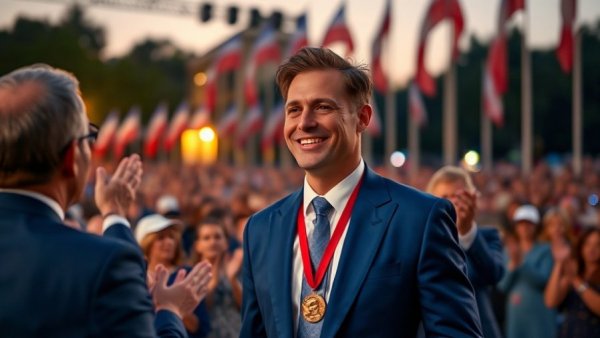
A New Face in French Politics: Teddy Riner's Bold Presidential Bid
The French political landscape shook with excitement as Olympic champion Teddy Riner announced his candidacy for the presidency in the April 2027 election. The renowned judoka, known for both his prowess on the mat and his impressive achievements—including two Olympic gold medals—approaches politics as an outsider determined to bring fresh perspectives to a nation embroiled in unrest.
Riner's candidacy coincides with intense protests across France, initially sparked by students demanding educational reforms and fueled by broader frustrations regarding the cost of living. His entry into the political arena highlights an important moment in French history, where established norms are being challenged by untraditional leaders seeking to resonate with disenchanted citizens.
“I know what people will say about me: ‘He’s mad. He isn’t part of the establishment,’” Riner stated in a video and added, “If refusing to bow my head and refusing chaos makes me mad, then yes, I am completely mad.” His candidacy not only seeks to address pressing issues but also to rebuild the trust between the government and the people, particularly the youth who feel left behind by a system that hasn’t delivered on their needs.
The Roots of Unrest: What’s Driving French Protests?
The protests that erupted in France over the past months are rooted in a deep-seated frustration with the education system and socioeconomic disparities. Students have taken to the streets in mass numbers, demanding better funding for education, and their grievances have sparked nationwide demonstrations. This social unrest has been characterized by both peaceful protests and violent clashes with police, highlighting an urgent need for change. As these dynamics unfold, Riner has emerged as a voice of hope, believing that a fresh approach is necessary to tackle the issues effectively.
Currently, President Emmanuel Macron strives to restore balance following increasing violence during protests. In recent addresses, he acknowledged the necessity for enhanced conditions in schools while condemning violence, asking for unity during these tumultuous times.
Is a Political Outsider the Answer?
Riner’s candidacy brings an interesting question to the forefront: can a political outsider succeed where seasoned politicians have struggled? Many view his lack of political experience as a disadvantage, particularly concerning the intricate task of securing the requisite signatures from elected representatives to run officially. However, supporters argue that Riner's life in sports—a realm filled with discipline, perseverance, and resilience—parallels what is needed in today’s political climate.
His focus on “common sense, firmness, justice,” as stated in his videos, resonates with those yearning for a break from typical political rhetoric. At the very least, Riner's campaign signals a shift toward more diversified representation and potentially draws in younger voters who feel disconnected from conventional candidates.
The Ripple Effects of Political Engagement among Athletes
As we delve deeper into Riner’s campaign, it’s essential to acknowledge a growing trend of athletes stepping beyond their sports to engage with social and political issues. This evolution ties back to the concept of athletes as role models; their influence can stimulate civic engagement among younger individuals. With a figure like Riner championing change, discussions about physical health and political activism are merging.
In regions like the Grand Strand of South Carolina, where healthy living and community involvement are priorities, Riner’s journey may ignite similar interests. Residents of Myrtle Beach, North Myrtle Beach, and other communities may relate to Riner's position in striving for common good, even if discussing politics is typically outside their realm of conversation.
A Call to Action: How You Can Get Involved
As Riner's campaign unfolds, it serves as a crucial reminder for citizens to engage in their systems, whether through voting, activism, or community discussion. Residents from places like Surfside Beach, Little River, and Garden City can participate in shaping their local environments by discussing ideas, supporting candidates who align with their views, or even being an advocate for issues important to them.
The spark of hope that Riner provides as he navigates this unprecedented journey through the political landscape may inspire everyday citizens to stand up and take action for their interests, particularly in a time where collective voices are paramount.
Now is the time for proactive engagement! Participate in local meetings, understand the political processes, and be vocal about your community's needs. Together, let’s drive positive change in our neighborhoods and beyond, just as athletes like Riner are attempting to do on a larger scale.










Write A Comment